Tuesday, August 4, 2015

Western Connecticut Farm Crawl

by Bill Duesing


For August, I'm taking a vacation from the Gleanings essay to highlight a few long time CT NOFA members and their farms.

On an absolutely beautiful early August Sunday, the long running New Milford Farmers Market sponsored its First Annual Western Connecticut Farm Crawl, an open house at many of the farms which sell at the market. Three of the farms are certified organic.  I got to two of them and one other.  I learned a lot.
  
Riverbank Farm
David Blyn and Laura McKinney of Riverbank Farm

David Blyn began growing vegetables on a half acre of Riverbank Farm in 1991, during a downturn which slowed his carpentry business.  His bottom land along the Shepaug River in Roxbury responded well and he was hooked.  (I remember another long time farmer and  CT NOFA member Mel Bristol of Bloomingfields Farm being astounded at the amount of produce David brought to the New Milford Farmers market in the early days and that he sold it all at $1 a pound.)

In 1996 David met Laura McKinney who had just completed the sustainable agriculture program at the University of California at Santa Cruz.  (That program is now taking applications for scholarships for its six month program which begins in April, 2016.  Steve Munno, CT NOFA board member and farmer at Massaro Farm in Woodbridge is another graduate of that program.)

Now, nearly twenty years later, David and Laura have three daughters and sell at seven summer and two winter markets. David says their oldest daughter who is 13 can handle a market by herself. David reminisced about the time when he was on the CT NOFA certification committee and the various farmers who were involved in that effort.  A special shout out to Wayne Hansen, who was the inspector, and Guy Beardsley, both of whom are still growing certified organic vegetables. (CT NOFA certified organic farms in the state from the late 1980s until the USDA took over organic in 2002.)
  
Here are some pictures of Riverbank farm from yesterday.

David Blyn and farm visitors studying the cultivating tractor David converted to electric using golf cart technology. In 2013, David brought this tractor to the Winter Conference and shared his knowledge in a workshop.

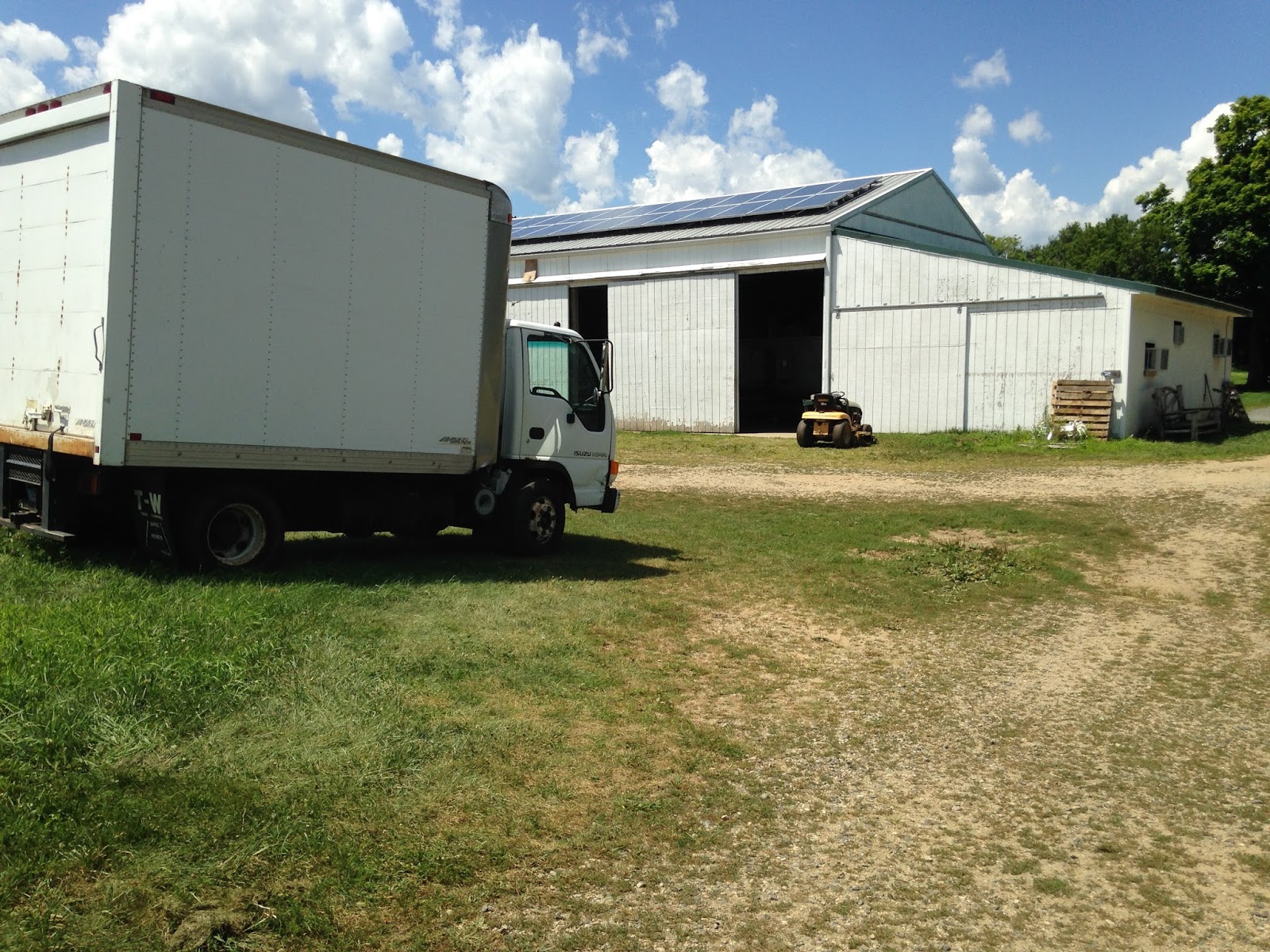
Riverbank Farm. Both Riverbank and Fort Hill Farms have photovoltaic arrays. They both emphasized repeated plantings throughout the season. Here are the most recent plantings of cucumbers and squash.

Riverbank Farm packing area. Trucks, one dedicated to each market,
can pull into the shade to load up.
 

Some of Riverbank's equipment. David speaks of the advantages of having separate equipment dedicated to different tasks, especially with a large farm crew.

Riverbank's Root Crop Washer.  This was designed and is sold by organic farmer and former NOFA NY president Dick de Graff of Grindstone Farm.
 
Fort Hill Farm

Paul Bucciaglia and
Rebecca Batchie
Then I visited Fort Hill Farm in New Milford, run by Paul Bucciaglia and Rebecca Batchie. Paul grew up in Naugatuck, CT, studied agriculture at Penn State before beginning graduate studies in plant biology at the University of Minnesota.  However in the mid 1990s, he worked on an organic farm near the Twin Cities and decided to leave the laboratory for small scale organic farming.  Beginning in 1999, Paul apprenticed at Brookfield Farm CSA in Massachusetts and then managed Holcomb Farm CSA in Granby, CT for two years before leasing 20, flat, sandy acres of protected farmland in New Milford owned by the Sunny Valley Preserve, part of The Nature Conservancy.   (Sunny Valley owns and leases out a number of farms in the area. They specifically wanted an organic farm when they connected with Paul in 2002.) Paul started that fall by plowing four acres of the larger, long time hay field. That was the beginning of his continuing work to improve the sandy soil with compost and minerals. (He is currently focusing on the role of silica in growing healthy Cucurbits.) Rebecca, with a background in horticulture that leaned toward vegetables, joined Paul on the farm in 2011 after earning a degree in Critical Social Thought from Mount Holyoke College. Their son Luca just turned two. 


Both Riverbank and Fort Hill farms are very involved in creating the next generation of successful vegetable farmers. Their workers, interns and apprentices have gone on to start or work on many other farms.  Mark Palladino of Wild Carrot Farm is one example I am familiar with.  He went from an office job dealing with numbers to being a successful certified organic vegetable farmer after working at Riverbank Farm. Mark farmed on leased land in Canton for a number of years before finding his current location in Bantam.


Here are some photos of Fort Hill Farm.


Paul didn't talk much about his CSA. It is so popular and his customers are so loyal that the wait list rarely opens up and it can take years to become a member once you are on the wait list.  His distribution strategies, vegetable choices and growing skills are very attractive.  These signs from the distribution shed provide examples of the farm's approach and show which vegetables are currently available.


Paul has invested in five coolers, each used for a different purpose. One is set to 34 degrees and 100 percent humidity for rapidly cooling and storing greens.  One is warmer and dryer for squash and cukes.  Another set at about 65 holds tomatoes away from fruit flies and yet another stores potatoes at an appropriate temperature.  In the spring they use a small electric heater in one to get the ginger started.
  

Beef steak type tomatoes are grown in a greenhouse that only uses a little supplemental in the spring to get early tomatoes. In the fall, this greenhouse will be sown to spinach.

When Paul arrived at Fort Hill, there was no infrastructure, just a hayfield. Using the resources of Sunny Valley Preserve and various Federal and State agricultural program, they have created the needed infrastructure. Paul sees that as a public investment in this land which will always be a farm.
Lettuce seedlings
 
 Lettuce seedlings
 
Ailsa Craig onions drying in a greenhouse


Fort Hill's three bay high tunnel for heirloom tomatoes and specialty crops
 
In response to the interest in the health and flavoring benefits of ginger and turmeric, Fort Hill has a crop of both those plants growing this year.

Paul is experimenting with growing organic pears and apples.

Batavian lettuces hold up well in the heat and are popular with customers
 
Flowers are pick your own for CSA shareholders
Paul in front of his sweet potato field.  The crop does well in the farm's sandy soil and is popular with shareholders.  Notice the sweet corn on the right. Sweet corn and strawberries are two crops his shareholders also really like.  When Paul and CT NOFA hosted an organic IPM workshop at Fort Hill some years ago, he mentioned that marketing his corn through the CSA was part of his organic IPM strategy.  His customers really like organic sweet corn and are willing to tolerate the few worms that get past his organic control using Bt.

Because of sandy soil and limited well capacity, they irrigate in a variety of ways.  This water reel is used at night. In the heat of the day, drip irrigation is used on mulched tomatoes. 


Happy Acres Farm

Cows on grass at
Happy Acres Farm
Paul recommended that I visit Happy Acres Farm in Sherman next. Mel and Diana Bristol and other friends who live in Sherman had told me how excited they were that their town had purchased the nearly 100 acre Happy Acres Farm and had accepted a proposal from two young men to raise grass-fed beef in order to maintain and improve the beautiful valley farm with land along both sides of Route 39 north of Sherman center and south of the Bristol' s farm.

I didn't know until I read this article from across the Atlantic in The Guardian that these two young men had met at Riverbank Farm. At the time environmental writer John Motsinger was volunteering to learn more about farming and Adam Mantzaris was making the transition from biomedical engineering to farming, inspired by Michael Pollen's The Omnivore's Dilemma.

I had met John and Adam earlier in the year when they consulted with me about organic certification at CT Farm Risk Management's One-on-One advising sessions. These sessions are another important resource for new and any other farmers who have questions about regulations, legal matters, land transfer or other issues and want to talk privately with an expert.  These free sessions are scheduled in locations throughout the state for late winter or early spring if funding is available. Check here for more information later in the year.


Sarah and some of the vegetables
she is growing in the first year garden
at Happy Acres farm.
A woman's perspective is so important for a farm. Each of these farms involves strong women; the men spoke respectfully of their roles.  I was very happy to see Sarah at Happy Acres who I'd met many times when she was Guy Beardsley's best worker at Guy's EcoGarden in Shelton. (You can hear Guy at noon on The Organic Farmstand, the first and third Thursday of each month on WPKN, 89.5 from Bridgeport or at WPKN.org) This year Sarah established the vegetable garden at Happy Acres.  Sarah also worked at Riverbank Farm for a while.  Vegetables and grass fed meat are sold at Happy Acres farmstand.  Meat is also sold at several farmers markets.

Here are some photos of Happy Acres Farm
 
Fields along Route 39 which the cows will be rotated through two acres at a time.
 
Adam Mantzaris of Happy Acres Farm with goats that have been trained for brush clearing on the farm. They were temporarily contained pending an electric fence repair.
 
John Motsinger with a dairy heifer belonging to a young man who hopes to start a dairy and is trading farm work for heifer housing and care.

More views of Happy Acres Farm


Topmost Herb Farm

Carole Miller
The day before the farm crawl, Suzanne and I were invited to a friends and family blessing for Carole Miller, a very long time CT NOFA member and owner of Topmost Herb Farm in Coventry. In 2001, Carole opened her beautiful farm to CT NOFA for its Taste! Organic Connecticut Event, which included an organic farmers market, local organic food, cooking demonstrations, classes and music.  It was one of the first destination markets in the state and one of the first public outings for the Big Green Pizza Truck which started a continuing trend in this state.  Carole provided the venue for seven more years, each one hosting 700 to 1000 happy people.  Taste! moved to Manchester Community College for two years until the growth of exciting weekly farmers markets including organic farmers made Taste! less important.


Carole is an important organizer, volunteer and vendor at the Coventry Regional Farmers Market. On this TV talk show, Carole reminisces about growing up near her current farm, how she got interested in herbs and organic methods.


Hopeful Examples

It is not easy to rebuild our current food system which is broken in so many ways: dependent on lots of fossil fuels and dangerous chemicals, on very long distance transportation and on very low paid often immigrant labor. These young and not so young Connecticut farmers provide hopeful examples of the ways we can create holistic, organic solutions to feeding ourselves with healthy food at fair prices. There is little that is more important for our future.


Monday, June 29, 2015

Two Visions Revisited


by Bill Duesing


There has been remarkable positive movement toward growing food for people near where they live, which is often called agroecology. Methods used in this local, healthy and sustainable food system model maximize use of local resources, including sun and waste products and minimize use of fossil fuels, agro-toxins and abuse of people.

Almost two decades ago, I was inspired by a speech delivered by visionary organic farmer, Fred Kirschenmann, to write "Two Visions" for my October 3, 1997 Living on the Earth broadcast. 

Two Visions

Two distinctly different visions for the future of our food system have emerged: one is industrial, the other is ecological.

The industrial paradigm urges society to amplify research and the application of intensive, high-input technologies for growing, processing and marketing food in order to feed an expanding human population.

Proponents of the ecological paradigm for our food system believe that if the human species is to survive, the work of feeding ourselves must be incorporated into the "larger task of restoring the health of local ecosystems" and communities. They "suggest that this requires not only a redesign of farming methods, but also of the entire food and agriculture system." Producing and preparing food should become an integral part of our lives.

The basics of a food system are really quite simple. Soil supports plants which use sunlight to turn air and water into delicious things to eat. Animals turn some of the plants into other good food. Meals are prepared and eaten.

In the ecological model, the plants, animals and eaters share the same ecosystem. Wastes from one species nourish others by way of nature's elegant cycles. Growing and preparing food are integral to the culture, education, joy and the spirit of each community. While home, school and community gardens are the most important elements of an ecological food system, community-supported-agriculture projects, farmers markets, organic farms, as well as small and part-time farms (especially in urban and suburban areas) are also critical. All of these human-scale endeavors are expanding steadily here in the US and around the world. Grassroots organizations believe that these elements help restore the health not only of people and local ecosystems, but of rural and urban communities, as well.

The approach of the industrial food system is very different. This system disconnects people from direct experience in producing food and disconnects food production from the elegant natural cycles that allow ecosystems to function. Instead it creates concentration of ownership, extremely large-scale monocultures and highly-subsidized facilities which produce, for example, millions of hogs or chickens, millions of pounds of margarine or millions of gallons of herbicide each year. It also tends toward boring, inhumane and oftentimes dangerous employment for its workers.

Because food is produced very far from where it is eaten, distribution becomes the most important element in the industrial model. Large agribusinesses use contracts with farmers, vertical integration and other forms of coordination to control the flow of food from "farm to mouth." Large chemical, drug, seed and equipment companies take an increasing share of farmers' earnings for their high tech, toxic, dangerous, and genetically-engineered inputs. Globalization of all these activities is big right now, with the overriding goal in all cases being higher profits to please investors.

While the ecological approach maximizes the use of solar energy, recycles organic wastes and uses non-renewable resources sparingly, the industrial approach voraciously consumes soil, water, packaging materials and energy.

In fact, energy from fossil and nuclear sources used for growing, processing, transporting, packaging and marketing has become the most important ingredient in the industrial food system.

This system discards farmers and their knowledge as it eliminates locally-adapted plants and animals in favor of laboratory creations. The industrial system is quickly narrowing the diversity of food plants that we eat and the diversity of plant and animal species on Earth.

Proponents of the industrial vision would have us forge recklessly ahead on their path, putting all our hopes for future eating into the hands of genetic engineers, large-scale, far-away farms and global food processors. Their record so far is not good.

Practitioners of the ecological system strive to involve as many as possible in the rewarding work of feeding themselves. They have found that local, ecological food production nourishes more than bodies. It nourishes spirits and communities, too.

(This transcript, and those from all of my weekly Living on the Earth broadcasts from late 2005 through the fall of 2010 are archived online by the University of Massachusetts Library. The special collections unit there also houses the NOFA archives.

Progress

That was 1997.  The issues haven't changed much.  Progress in the last 18 years, however, toward the ecological vision is evident all over Connecticut (and indeed the planet). It is inspiring what people can do. There has been a veritable explosion of gardens, small farms, community farms, college farms, farmers markets, and food and farming related organizations.  Each of these inspires and connects more people directly with their food. 

In 1997, the Hartford Food System and at the time, all-volunteer CT NOFA had been around for about 20 years and Common Ground High School (on a farm in New Haven) was just beginning.  The founding of the Working Lands Alliance and from that the Connecticut Farmland Trust wasn't even on the drawing board.  Farmers markets were few and mostly small.  There were only a handful of CSAs (Community Supported Agriculture farms) offering a weekly share of the produce. 

In this century, notable markets such as CitySeed's four in New Haven and the famous Coventry Regional Farmers Market got going.  Those markets and others all over the state stimulated farmers to produce more food and grow more kinds of crops for a longer season. They encouraged a wave of new and young farmers which in turn encouraged CT NOFA and UConn to begin beginning farmer-training programs.  The new farmers started their own organization, the New CT Farmer Alliance.

Community Farms are one of the most promising of these developments.  They are run by non-profit, community-based organizations to produce food for people where they live, to provide education and a connection to the soil. Bridgeport, Hartford, New Haven, New Britain and New London all have one or more community farms. Many suburban towns have them too, connecting with school children and enthusiastic volunteers from local businesses. The Community Farm of Simsbury trains new organic farmers as well as providing food for the needy.

Land trusts and churches are growing food for food pantries and towns are establishing Agriculture commissions.  There's now a ConnecticutFood System Alliance.

In our town, the number of people producing eggs and maple syrup increases each year.  More of our neighbors are growing their own food.

We have a long way to go, but based on this growth and the concomitant benefits (called positive externalities) they have a very promising future.

Small Farms Feed 70 Percent of the World's Population

Local agriculture has a good track record.  According to a report from the ETC Group, 70 percent of the world's population is fed by a variety of peasant and small-scale food systems.  The ETC Group is an international organization which is dedicated to "the conservation and sustainable advancement of cultural and ecological diversity and human rights." It traces its roots to Eleanor Roosevelt's work to help poor, mostly black tenant farmers in the 1930s.

That means that only 30 percent of the earth's population is fed by the agro-industrial food system.  However, the system that fills our supermarkets and chain restaurants to overflowing uses 75 to 80 percent of the arable land and 70 percent of the water and fuel used for agriculture. Not so efficient, but they always want us to buy and consume more.

Despite the widespread benefits of agro-ecological systems, the agro-industrial system is growing steadily because of its power and wealth, and the fact that it can spread many of its real costs (called negative externalities) elsewhere: the planet, people, even, maybe especially, farmers. Recent news provides good examples.

Big agriculture was a huge supporter of the recently-passed Trade Promotion Authority (and the Trans Pacific Partnership that it enables) in part because it would mean more hog factories and more corn and soy farms to feed them in Iowa. (To my thinking, more hog factories is a sufficient reason to reject this trade process.)  However, as one farmer there said, "It's really important that we are able to export our product.  We have a moral duty. We're feeding the world here."  I guess she hadn't read the ETC report about who really feeds the world.

This chart indicates the drastic reduction in diversity of crops on Iowa farms in the last century. You can imagine a lot of delicious meals on farms and in communities in 1920. Especially since many of the farms had large, bountiful gardens, too. It would be tough to eat well from the farms in 2002.  Any other crops are only grown, if at all, on less than one percent of the farms. All the Roundup, and now 2-4,D to control weeds in the GMO corn and soy makes gardening much harder.

External Costs

One aspect of the system used to produce more pork for people to eat in Asia is particularly negative: the millions of tons of nitrogen applied to and leaking from corn fields and draining out of confined hog feeding operations. Nitrogen is a critical ingredient for growing corn to feed pigs, cows, chickens, people and cars. (Covering 90 million acres, corn is the most widely grown crop in this country.  Except for the produce section, corn is a part of almost everything in the supermarket: meat, dairy, one or more ingredients for many processed foods and a key ingredient in soda.) 

A recent study by an international team of scientists found that the annual human and environmental costs of nitrogen pollution attributable to agriculture is twice the value of all the corn produced!  The nitrogen running off of farms and animal factories already adds a million dollars a year to the Des Moines, Iowa water company's costs.  Nitrogen is also a major cause of the dead zone in the Gulf of Mexico (the size of Connecticut this year, I hear) and the trouble in our own Long Island Sound. Nitrogen fertilizers also release greenhouse gases when applied to the soil.

Nitrogen pollution is just tip of the iceberg when it comes to the environmental costs of the industrial approach to growing food. Broad spectrum herbicides and insecticides greatly diminish biodiversity and resilience, above and below ground, over vast swaths of the Midwest which was once one of the planet's most diverse and productive ecosystems.

And, it looks as if even the farmers who apply the nitrogen will bear some of the costs this year.  According to the University of Illinois, farmers who grow corn in central Illinois, some of the best land in the country, may lose money on every acre they harvest after paying rent for the land.  However, we taxpayers will make up some of the difference through crop insurance and other subsidy programs. You can see complete crop budgets here.

The barrage of low cost meat and processed and fast food adds another external cost - to human health.  A recent Brookings Institution Study found that "if all of the American children who are now obese mature into obese adults, the cost to the nation would be $1.1 trillion in additional health care expenses and lower productivity over their lifetimes." What are the costs of other diet-related diseases such as diabetes, cardiovascular disease and dementia?

This system is clearly not sustainable.  Environmental pollution, farmers driven out of business and sick people do not bode well for our future. 

And yet industrial agriculture isn't giving up.  It is deeply committed to growing more of a few, largely genetically-modified crops for processing into foodstuffs to be shipped to wherever people have money to pay.  As Richard Manning says in his very thought-provoking and provocative, 2004 book, Against the Grain: How agriculture has hijacked civilization, "The goal of agriculture is not feeding people; it is the accumulation of wealth."  Powerful voices from many public sectors are aware of how unsustainable and dangerous the industrial food system is. And they are speaking out about it.

Pope Francis, for example, recently said: “A true ecological approach always becomes a social approach; it must integrate questions of justice in debates on the environment, so as to hear both the cry of the earth and the cry of the poor.”

And The People's Test on Climate in 2015 stated: "Nothing less than a systemic transformation of our societies, our economies, and our world will suffice to solve the climate crisis and close the ever-increasing inequality gap."

It's challenging work to make social change, but in this case, our lives depend on it.


Tuesday, June 2, 2015

Product and Process

by Bill Duesing

To understand the importance of organic agriculture, we need to look beyond the difference between the possible pesticide contamination of conventional produce and the possible blemishes of organic produce.
Organic farming and gardening work by using the processes that have allowed the Earth to evolve to its current beautiful and exciting state.
Photosynthesis, the growth, death and decay of an incredible variety of organisms, constant change and the nearly total recycling of materials are the processes of nature and of organic agriculture.
This agriculture uses sunlight, carbon dioxide, water, minerals, local waste products and the genetic information in seeds to build and maintain complex ecosystems. These ecosystems produce food while they build topsoil and fertility, hold water, protect diversity and create beauty and pleasant work.
This contrasts with the focus on the product in our current food system, which in striving for the perfect marketable fruit or vegetable, is willing to use toxic materials and methods such as monoculture, widespread irrigation, and annual agriculture on the dry high plains to produce its product. The results of this approach are soil erosion, depletion of aquifers, pollution of wells, a decline in the diversity and stability of our ecosystems, and one of the most energy- intensive food systems in the world.
Long-distance food shipping, modern packaging, processing, freezing and food-irradiation techniques have put an ever greater amount of energy, time and space between the plant absorbing sunlight and the reversal of that process in our bodies, as energy is released from the food.
Our current food system (and therefore our ability to live) is dependent on Chile's political stability, Mexico's pesticide regulations, California's water resources, Kuwait's oil, a small and shrinking number of farmers, and the very few corporations which control any given commodity.
This focus on product has produced farmers who grow a square mile of wheat and then buy all their food from the supermarket. Peasants in Mexico labor to grow winter vegetables for us on land that used to produce corn and beans for them. Many can barely afford the imported American fast food they now get to eat. The traditional small farms of old and New England, with vegetable gardens, small orchards, chickens, cows and a few pigs, produced most of the fertility for the farm and the food for the farmer's family, with surpluses of several kinds for their neighbors. This agricultural model is nearly forgotten and almost extinct.
Our current system uses fossil fuel-powered factories instead of leguminous plants like peas and clover to obtain nitrogen. We grow lettuce (which is 95 percent water) in the desert and then use oil to move it 3,000 miles to our mouths. We use millions of pounds of chemicals that are toxic to much of the life on our planet, but the apologists for the chemical industry say it's okay because there is little or no residue left on our food. The cheapness of taxpayer-subsidized chemical fertilizers, pushed by industry and their government partners, has caused materials like food wastes, animal manures, and leaves to change from being valuable resources, to being garbage—now a global problem.
The real key to organic gardening and agriculture is a healthy soil, full of living things (6 billion to a teaspoonful) and decaying organic matter. The understanding and care needed for good garden soil is symmetrical with the understanding and care needed by our Earth.

I wrote and delivered this essay in the winter of 1991, nearly a quarter of a century ago, early in the decade-long series of my Living on the Earth radio pieces on WSHU from Fairfield, CT. It was included in the collection Living on the Earth: Eclectic Essays for a Sustainable and Joyful Future published in 1993. I'd certainly use a few different details now: perhaps Mexico's political environment, China's pesticide regulations, and fracked natural gas. And California's water resources are worse than ever.
I dedicated this essay to NOFA/CT as the Northeast Organic Farming Association of Connecticut was then known.  At the time, CT NOFA was a small, all-volunteer organization that educated and advocated for a local and organic food system, certified organic farms in Connecticut and was just beginning its education and advocacy program in organic land care. NOFA was a pioneer in this work.
Think for a minute about the changes in the food and farm landscape in Connecticut (and nearly everywhere else) since that time. I believe that there is more local food availability now than at any time since the 1950s.
In the past 24 years, there has been tremendous growth in local, small and sustainable farms, in farmers markets, community and college farms, and many more young people are actually interested in growing food.  There are more community gardens and school gardens as well as a greater focus on food justice and sustainability. Enthusiastic believers in good food, social justice and ecological care now bring these issues to the educational, environmental and faith communities who are joining in this work. Farmers and gardeners are growing food in inner cities, in the suburbs and in traditional farm country.
CSAs or farm-share programs, food delivery businesses and farm stands connect growers and consumers in new ways.  Federal, state and municipal programs, local agricultural commissions, food policy councils and non-profit organizations support this growth in many ways.  Producers and consumers alike are excited by the increasing diversity of foods grown or produced here.  There are more kinds and varieties of vegetables available, many year round, as well as cheeses, fruits, grains, meats, other dairy products and fungi.  Nearby food is fresher, tastier and better for the climate. It has helped to create vibrant communities around farms and markets, as people learn more about our essential connection with Earth.
Meanwhile, in the intervening years, genetically-modified seeds have become the norm in the industrial system.  The first round of herbicide tolerant crops is failing to perform (because nature works like nature and evolves) so soon our industrial food crops will be sprayed with a cocktail of not one, but two toxic herbicides.
Agricultural suppliers, commodity traders, meat processors and food marketers have consolidated to gain market share at the expense of farmers, consumers, democracy and the planet. They all seem to have unlimited money for lobbying and marketing and to make sure we don't know which foods come from genetically-modified seeds.
This evermore distant, industrial, capital intensive, high-tech food system marginalizes and impoverishes farmers for the benefit of the folks who control the inputs as well as the space between the soil and our mouths. This system has also caused an enormous increase in the very expensive chronic diseases which are diet related: diabetes, cardiovascular disease, obesity, and some cancers. Besides the confined animal feeding operations, food processors and fast food operators, other beneficiaries of this system include the venture capitalists who buy and sell restaurant chains like so many monopoly pieces in order to take advantage of cheap food inputs and tax benefits.  In contrast, this year, Illinois corn farmers, growing on some of the best farmland in the world are projected to lose money on every acre they harvest. Wisconsin dairy farmers are going out of business because of plummeting milk prices which approach just half of their production costs.  Clearly something is very wrong.
The industrial system and its allies are now in a full court press to convince us that its way is the only way to feed ourselves. It is exciting that so many people are involved in the critical work of re-creating a local, sustainable and just food system.  It is likely to take much of our energy for the rest of our lives to make this happen. However, the vision of a triumphant industrial system that destroys biological and food diversity, worsens climate change, pollutes the planet with excess nitrogen, drives farmers out of business and greatly increases health care costs, is bleak indeed.  
So grow some or more of your own food, find farmers or a community garden in your area, learn to eat and cook local, seasonal food. These are the most powerful things we can do for our health and the health of the planet that our grandchildren will inherit.

Monday, May 4, 2015

Hail to the Dandelion!

By Bill Duesing


Little is more emblematic of our culture's dysfunctional relationship with Earth than our relationship with the dandelion. We spread cancer-causing, chemical toxins around our homes and public places to kill plants that produce healthy and delicious dark green leaves (and may also help cure cancer). Check on pesticide toxicities here. Meanwhile we eat store-bought dark green leaves (which are mostly water), packaged in plastic and grown 3,000 miles away in a state in its fourth year of serious drought.

I really enjoy snacking on dandelion leaves when I'm working in the garden. Dandelions were the last food I harvested outside in January before the snow buried everything and the first green leaves we ate this spring.  Besides garden snacks, we've used these vitamin-rich greens in salads and stir fries for at least a month now.

Although I've long appreciated the dandelion as a harbinger of spring, have snacked on and cooked the leaves for decades and have even made earthy wine from the flowers, I hadn't actively cultivated dandelions until last year.  I started getting serious about this when the advantages of growing perennials to improve soil health finally sunk in.  Disturbing the soil damages it.  Perennial crops cause far less soil disturbance.  We've grown a number of perennials for years: strawberries, raspberries, blackberries, blueberries, hazelnuts, mints and other herbs, garlic chives, comfrey, horseradish, grapes and more.  Dandelions are perennials that already grow in the garden.  Why not weed around them as we do with clover, another valuable perennial, and learn to harvest and eat them?

Important Connections

Dandelion roots
Plants connect the atmosphere and the soil.  Whenever they are photosynthesizing, they are pumping a variety of carbon-containing compounds (called root exudates) into the soil to feed soil organisms.

Those organisms - billions of bacteria, fungi and the rest of the soil food web - respond to chemical signals in the root exudates and provide the specific nutrients that plants need.  Managed properly, this process can also result in carbon being sequestered in soil organic matter, helping to fight or reverse climate change.  That's why bare soil is such a violation of nature - it starves the soil organisms.

Dandelions photosynthesize between nine and ten months a year, so they are feeding soil organisms all that time, probably with a variety of helpful exudates mirroring the complexity and richness of the leaves' contents. Their tap roots open up passages deep into the soil for water, air and organisms.  When leaves are picked, some of the roots die and slough off to keep the plant in balance. This adds more carbon to the soil. (Managing this process on pastures with careful grazing can result in large increases in soil carbon.)

The dandelion is scientifically known as Taraxacum officinale which translates roughly to "the official remedy for disorders." All parts of the plant have been used medicinally for more than 1,000 years. Dandelion greens have at least as much vitamin A per gram as any food except red hot chile peppers and liver, more potassium than bananas and more calcium per gram than whole milk. Its leaves have been fed to English racehorses to build strength and health and used to make beer.  Recipes are here for the flowers, here, here and here for leaves. I favor the last one with the double garlic and ginger or capers.  We've never boiled the dandelions before cooking.

The bright yellow dandelion flowers also make an earthy wine. About one gallon of flowers makes a gallon of wine. The leaves are said to get more bitter once the plant flowers, but that is a matter of taste.

Dandelion root is a diuretic. As such, it may be useful for premenstrual syndrome, high blood pressure and congestive heart failure. It is said to be good for the liver and to help prevent gallstones, too. A dandelion root extract is currently in clinical trials in Canada to study its cancer-killing effect.

Dandelions provide important above-ground benefits to the ecosystem too. Honeybees and at least 92 other insects collect its nectar and/or pollen. Birds are fond of its seeds.

Dandelion as Target

Yet, advertising images of dandelions are a marketing tool for toxic pesticides.  That's the way most Americans probably think about dandelions. Selling more of and getting greater profits from whatever it is that you are making or selling is the name of the game in this system.  But if certain real costs (to the environment, taxpayers or society) aren't included in those calculations, we have flawed and expensive results.

Our current system is clearly not sustainable.  Undifferentiated, exponential economic growth is a dead end. A simple example is the increase in bigger garden centers stocking larger piles of weed and feed lawn products (combinations of one or more herbicides with water-polluting fertilizer) to sell to more homeowners and landscapers who become further disconnected from reality. Where will it end? In many ways and places, we are reaching the limits of the damage we can do to our environment and still live here.  There are definitely limits to the disconnection we can tolerate between marketing and ecological reality if we are to survive.

Cultivating lettuce in the California desert
In our kind of economic/political/cultural system, the costs (toxicity, fewer soil organisms and bees, less stored carbon and perhaps more cancer and disease) are spread broadly throughout society and the environment. Concurrently, the profits are concentrated more and more in fewer and fewer hands.  A recent report compiled for the United Nations showed that many of the world's most profitable industries would not have any profits at all and could actually have very large losses if environmental impacts were considered.  And that study ignores social costs and taxpayer subsidies which would decrease the profits of pesticide, big ag and many other industries even more.

Learning about dandelions, their relationship with other living things and the costs of having them as an enemy provide a model of the kind of holistic thinking needed for our survival.  Everything is connected.

Coming to the rescue is the idea of holism, of using all the costs and benefits to guide us to a sustainable future.  I'm not an economist, but I like what I see in the Capital Institute's report Regenerative Capitalism: How Universal Principles And Patterns Will Shape Our New Economy by former banker John Fullerton. In consultation with a diverse advisory group, he produced this report which explores using holistic thinking and planning to address the problems our very un-holistic system has caused. More on this in the future.

So next time you see a dandelion, think of it as an ecological champion and delicious food and remember the importance of holistic thinking.  It has long been a part of the organic gardening, farming and land care movement.

To learn more about caring for your yard organically visit organiclandcare.net and see especially this downloadable booklet.