Showing posts with label Northeast Organic Farming Association. Show all posts

Tuesday, December 16, 2014

Winter Conference Teaser: Improving Food Access, Raised Bed Gardens and Seed Saving!

The Winter Conference is 3 1/2 months away!

We will begin counting down to CT NOFA's largest celebration of local and organic food, farming and community with a glimpse into to line-up each week showcasing a few workshops we have recently announced.  


Improving Food Access Through Farmers Markets, CSAs, and Mobile MarketsDan Gregory & Pauline Zaldonis
"In this workshop, we will give an overview of Hartford Food System's efforts to improve food access in the City of Hartford. We will also go over various low-income inclusive CSA models and how to increase market revenue by accessing state and federal initiatives such as SNAP, WIC, and FMNP."


Dan Gregory is the farm manager for the urban farm, Grow Hartford. The farm offers subsidized low-income CSA shares and sells at local farmers markets in Hartford. Pauline Zaldonis is the program coordinator of the Hartford Mobile Market and policy analyst for Hartford Food System.

Monday, November 3, 2014

Fueling up in Cheyenne, Wyoming


An array of fueling options at a gas station in Cheyenne, Wyoming.
Even the gasoline contains a corn product-it is 10 percent ethanol.
The wastes from making ethanol are fed to
beef and dairy cows, pigs and chickens.
Fueling up in Cheyenne, Wyoming
By Bill Duesing

The American way of eating is shaped more by the availability of low-cost fossil fuels and government crop and other subsidies than it is by nutrition, health or flavor.

I took the photo above while buying gasoline at a station in Cheyenne, Wyoming this summer. This array is an example of the ubiquitous advertising for these kinds of foods: ground beef sandwiches, often with bacon and/or cheese or processed hot dogs on white bread buns. (For the chicken nuggets, their wheat breading is the bun equivalent.)

It also made me think about the health consequences of eating this kind of food: weight gain, obesity, diabetes, sore joints, heart disease, cancer and possibly even schizophrenia!

Why are foods that may cause so much damage so heavily advertised? A rhetorical question really. The answer: profit.  Much of that profit comes because food industry accounting doesn't include many significant costs.  Health care costs are not included.   The illnesses above, and the foods that cause them, are responsible for millions of dollars in health costs.

Wednesday, October 1, 2014

Climate Change and Organic Agriculture

By Bill Duesing

Many of us participated in the inspiring People's Climate March on 9/21/2014 in New York City. Marchers represented a wide variety of religious, educational, environmental, energy, social justice, peace, health, labor, cultural and other organizations.  Though they all had their own agendas for solving problems and making the world a better place, they agreed that climate change is very serious and needs to be addressed.


From right, soil scientist, permaculturalist and CT NOFA founding Board member Cynthia Rabinowitz, CT NOFA Executive Director Eileen Hochberg and former executive director Bill Duesing at the beginning of the People's Climate March.
CT NOFA was a partner in the March. That day, I saw many CT NOFA members, including former board members and folks from many of our partner organizations. Many more NOFA colleagues were among the 400,000 participants in this resounding call for action on climate change.

Friday, August 29, 2014

Vermont Food Fight

By Bill Duesing

The month after Vermont governor Peter Shumlin signed into law the country's first genetically modified organism (GMO) labeling bill with a firm effective date, the Grocery Manufacturers Association (GMA), the Snack Food Association (SFA), the International Dairy Foods Association (IDFA) and the National Association of Manufacturers (NAM) sued in Federal Court to overturn the new law. This law is scheduled to take effect in 2016; there is no trigger clause requiring other states to pass similar legislation before it takes effect.

With foresight, the Vermont legislature established the Vermont Food Fight Fund to help defend the GMO Labeling Law.  A strong defense of Vermont's law should strengthen Connecticut's. You can contribute here. 

Why are these three multibillion dollar lobbying associations, representing the world's largest and most powerful corporations, suing to stop what the citizens want? After all, these citizens are their customers.  

Thursday, March 6, 2014

Inspiring Farmers in the Northeast at our 32nd Annual Winter Conference!

Swift Farms sold their amazing bees wax products
I don’t know about you, but the staff at CT NOFA is still bathing in the afterglow of an inspiring and successful Winter Conference!

The 32nd annual Winter Conference was held at Western Connecticut State University this past Saturday, March 1st and had over 900 people in attendance, a new record! The day started with attendees gathering in our vendor area where they were able to fill their free CT NOFA tote bags with literature and goodies from educational exhibitors, local farmers, and crafters! (A full list of vendors and exhibitors from the day can be found at HERE)

Tuesday, March 12, 2013

The GMO Labeling Movement Continues across the Country

Connecticut has new proposed GMO labeling legislation for this legislative session.  The GMO labeling bill was introduced by Diana Urban and Phil Miller.  The 2012 Connecticut labeling bill was dropped because of concerns that biotech companies could sue the state government, but the language of the bill is being altered this year to sidestep this obstacle.  The bill has ten co-sponsors in the Connecticut House of Representatives.  You can see the co-sponsors and the text of the bill at the state government's page for HB 6519.

There is a public hearing this Friday March 15th at 10:30 am at the Legislative Office Building, 300 Capitol Avenue, Hartford in front of the Public Health Committee.  GMO Free CT is asking supporters of the bill to come, even if only for a short period of time (they have buttons for you to wear!)  According to GMO Free CT: "Please come whenever you can, even if it is only during your lunch break. We will have Right To Know GMO pins for everyone to wear. We need your support. Our Legislators must see that their constituents want the right to know what is in our food."  You can testify in person or send a written testimony to PHC.Testimony@cga.ct.gov.  GMO Free CT can also give you the handouts you need if you want to set up a meeting with your legislator to talk about your support for the bill.  You can also write your legislator to let them know your about your support - GMO Free CT has a step by step how-to for you to find your legislator and write them.

In Vermont the  House Agriculture Committee approved a GMO labeling bill on March 1. The bill calls for foods made with GE or containing genetically engineered ingredients to bear special labels. A bill was approved by the committee last year, but too late in the legislative session for it to be voted on. 

All this comes in the midst of an exciting (though long awaited) announcement from Whole Foods that all products in its North American stores that contain genetically engineered ingredients will be labeled by 2018.  Whole Foods' decision is responding to a growing demand for products without GMOs.  According to this Connecticut Post article, Products that get a "Non-GMO" verification" label saw a sale spike between 15 and 30 percent.  Whole Food's labeling will be even more exhaustive than much of the proposed legislation because it will require labeling for meats and dairy products.

It's important to keep contacting our legislators and voicing this support.  You can also write a letter to the editor to your local newspaper - why not share with your community your support?

- Kristiane

Monday, November 19, 2012

CSA School Program on November 28

On November 28 in Haddam, CT the UConn Extension with the funding of the USDA Risk management Agency is hosting an all-day, intensive CSA School.  This is a great way to learn from other farmers about their experiences operating CSAs of all shapes, sizes and models here in Connecticut.  Check out the agenda:

8:30 Welcome- Jude Boucher, UConn Cooperative Extension
Who is your CSA customer? – Monique Basch

8:45 - 9:15 Traditional CSA Vegetable Share
Paul Bucciaglia, Fort Hill Farm, New Milford
Key elements of the CSA model

9:15—9:45 Multi-farmer CSA
Brad Isnard, Bishop’s Orchard CSA
Working with other farmers, using CSA share add-ons

9:45 – 10:00 BREAK
10:00 – 11:00 Multi-season CSA/Partnering with Chefs
Fred and Stacia Monahan, Stone Garden CSA, Shelton
Deciding to shift to CSA business and impact on farm income, layering CSA shares, aspects of managing large # of members

11:00 – 11:30 Meat CSA
Rick Hermonot, Ekonk Hill Turkey Farm, Sterling
Unique aspects of operating a meat CSA, share options, aggregating product from other farmers

11:30 – 12:15 LUNCH

12:15 – 1:00 Tips & Tools for CSA business management
Jiff Martin, UConn Cooperative Extension
Model CSA contract, share prices, communicating with members, case studies and snapshots, innovative aggregation models

1:00 – 1:30 Insuring a CSA
Joe Bonelli – UConn Cooperative Extension

1:30 - 2:30 Getting Started – What I learned my first year running a CSA
Farmer Panel:
 Michelle Collins – Fair Weather Acres, Rocky Hill
 Bruce Gresczyk Jr. – Gresczyk Farms, New Hartford
 Steve Munno – Massaro Community Farm, Woodbridge
Moderated by Jude Boucher, UConn Extension Center


2:30 - 3:30
CT NOFA will be hosting a roundtable discussion for farmers who are just getting started with a CSA, those who are looking to improve or scale up their CSA and a discussion about CSA Regulations.  The group will break out into smaller groups to learn about:

Group A – Getting Started – Led by Max and Kerry Taylor (Provider Farm)
Group B – Getting Better – Led by Steve Munno (Massaro Farm)
Group C – Regulating the CSA – CSA farm businesses and issues with town and
state government, led by Joan Nichols from the Connecticut Farm Bureau Association

Register by filling out this form and sending it to
UCONN, CES
24 Hyde Avenue
Vernon, CT, 06066

Hope to see you there!
Kristiane


Friday, November 2, 2012

Do or Die in California: OCA's Final Plea

A message from the Organic Consumers Association:

The final Pepperdine pre-election poll on the November 6 Proposition 37 California ballot initiative to label genetically engineered foods came out October 30. After enjoying a 26-point lead for the past six months, our side is now supposedly 10 points behind in the polls. The online poll, which in theory has a margin of error of 3-5%, was conducted before our Yes on Prop 37 TV ads finally began running last weekend. But the results are nonetheless alarming.

We still enjoy a lead among those who don't watch TV, but the opposition's ads have turned huge numbers of California TV-watchers against us.

For a full month Monsanto and their allies have pounded the California airwaves with nearly $50 million in TV and radio ads, spewing lies about how mandatory labeling for genetically engineered food will mean higher costs for consumers, lawsuits clogging the courts, "confusing" labels and poor farmers and grocers facing "nightmares of paperwork." Surveys have shown that once undecided or even opposed voters see our Yes on Prop 37 ads they change their minds, and come back over to our side. But we're running out of time - and money - to reach those voters. Meanwhile, money continues to pour into the opposition's campaign. Monsanto just upped its contribution this week from $7.1 million to more than $8 million.

We can still win on Nov. 6, by exposing millions of confused or undecided California voters to our TV ads. But we need to raise money, and we need to raise it today. Please click here to make a donation today.

In addition to running more ads, we need to step up our ground strategy in these last few days. Our 10,000+ volunteers for Yes on 37 are fighting back on the ground by talking to voters in front of supermarkets, sharing information with their friends by email and on Facebook, and by talking to prospective voters on the phone. These grassroots efforts will culminate in a major Get-Out-the-Vote campaign on November 6.

If you live in California, we desperately need you to hand out leaflets at grocery stores between now and Nov.6. If you can spare a few hours, please sign up here for instructions on where to get leaflets and where we need help.

If you live outside California, please volunteer for our national phone bank to help us call millions of California voters. It's easy. You can get quick, easy online training and sign up for one or more shifts here - and it won't cost you a dime in phone charges.

The "Do or Die" moment of truth has arrived in this David versus Goliath battle. The whole world is watching. We desperately need your emergency last-minute donations and your volunteer energy. Please support us in these last five days of this historic campaign!


Have a great weekend!
Kristiane

Thursday, October 4, 2012

California's Ballot Initiative is Only A Month Away

There is so much conversation going on about the safety of genetically modified foods and labeling laws!

There is this video of Troy Roush, a farmer that grows GE soybeans and corn discussing the essential right that a consumer has to know the details about the ingredients in their food.

There is also a live stream conference this Saturday, October 6 of the Seeds of Doubt Conference with our 2012 Winter Conference Keynote, Jeffrey Smith.  The speaker list includes Dr. Don Huber, Professor Emritus of Plant Pathology at purdue University and one of the leading scientists to test (and doubt) the safety of GMOs and Jeffrey Smith. For more information about the conference, visit the webpage. 

The "Yes on 37" campaign has also released new advertisements to battle with the anti-labeling campiagns going on in California.  Watch them here and share them on facebook and twitter!

Right now polls are showing support for the ballot initiative, according to the Los Angeles Times' video by Marc Lifscher.

This is all pretty good news given a recent paper published in Environment Sciences Europe found that Monsanto's Roundup Ready technology has resulted in increased usage of herbicides.  In Tom Philpott's article in Mother Jones, titled "How GMOs Unleashed a Pesticide Gusher" Philpott summarizes that the
study found:

"GMO technology drove up herbicide use by 527 million pounds, or about 11 percent, between 1996 (when Roundup Ready crops first hit farm fields) and 2011. But it gets worse. For several years, the Roundup Ready trait actually did meet Monsanto's promise of decreasing overall herbicide use—herbicide use dropped by about 2 percent between 1996 and 1999, Benbrook told me in an interview. But then weeds started to develop resistance to Roundup, pushing farmers to apply higher per-acre rates. In 2002, farmers using Roundup Ready soybeans jacked up their Roundup application rates by 21 percent, triggering a 19 million pound overall increase in Roundup use."

Monday, October 1, 2012

Join us at the CSA Fair this Sunday!

Community Supported Agriculture is more than a sustainable food movement buzzword, it is increasingly the distribution method that farms in Connecticut are using.  Community Supported Agriculture, or a CSA, is an opportunity for consumers to invest directly in their local farmers with an upfront membership fee, and then to receive shares of the harvest for an extended period of time.  There are over 60 CSAs throughout Connecticut, giving Connecticut consumers a wonderful opportunity to support local agriculture.  The Northeast Organic Farming Association of Connecticut (CT NOFA)’s new CSA Project strives to help you find the right CSA for you.
 
CT NOFA will be hosting a CSA Fair at the Downtown Country Fair at the Willimantic Food Coop on October 7.  Visit the CT NOFA table at the fair to receive more information about CSAs and for a list of the CSA farmers at the fair.  Meet the participating CSA farmers and talk to them about their farm and what their shareholders receive. Some of the farmers will be selling produce at the fair, this way you can try before you buy a share.
 
Our current list of participating farms is:Down to Earth CSA in Stafford
Shundahai Farm in Mansfield
Brown Paper Bag Harry's in North Franklin
Spring Lake Gardens in Sterling
McV Farm in Canterbury
Raspberry Knoll Farm in North Windham
 
There are a number of benefits for a CSA member.  Members usually pick up their shares at the farm where to food is produced, which provides an opportunity for children to learn about agriculture and where food comes from.  Members build a relationship with their farmer, and are not only customers, but are shareholders investing directly in local farmers. Each CSA offers different flexibility in terms of share size, pick-up frequency, season length, and products in the share.  If a share might be too much food as it might be for an individual or couple, ask your farmer if they offer half shares.  If there are only full shares, ask friends and neighbors if they would like to split a share and divide the food pick-up responsibilities.  If you receive foods you are unaccustomed to, your farmer will probably have cooking recommendations and recipes; they love good food as much as their members!
 
For a full listing of the CSAs in your area, visit www.ctnofa.org/CSAs.htm and view the listings by county.  The time to buy CSA shares is generally late winter or early spring before the growing season. Winter is the time to think about which CSA you would like to join, and initially contact a farmer to ask about their deadlines.  Keep an eye out for CT NOFA’s upcoming CSA Fairs in winter of 2013.  This rogram is supported by a grant from the USDA's Specialty Crops Funding distributed by the Conneticut Department of Agriculture. 

Thursday, September 13, 2012

The Farm Bill is the Climate Bill

Photo: Hoosier Ag Today
Yesterday, a few hundred farmers went to Washington, D.C. to rally for passage of a new farm bill.  The Democrat controlled Senate has passed a Farm Bill that eliminates all traditional farm subsidies and replace them with a system to compensate growers when revenue from a crop is more than 10% below average with crop insurance kicking in for deep losses.  The Republican-controlled House is arguing over a competing approach that cuts food aid to the poor.  Farmers want both sides to pass a bill to take effect on September 30.  The House leaders have declined to take up the Farm Bill, either the Senate’s version of the proposed House version.  Jennifer Steinhauer of the New York Times writes that House leaders “are not eager to force their members to take a vote that would be difficult for some of them, nor would they wish to pass a measure largely with Democrats’ votes right before an election.”

Yesterday the New York Times published a column by Mark Hertsgaard titled "Harvesting a Climate Disaster." Hertsgaard's column is about the farm bill acting as the United States' de facto climate bill and in their current forms, both the Senate and House versions of the legislation are "a disaster waiting to happen."
Hertsgaard sites the summer of 2012's extreme weather from the hottest July on record to the worst drought in 50 years.  Either bill will accelerate global warming by encouraging green house gas emissions and will make farms more vulnerable to the impacts of climate change.

Hertsgaard goes on to explain that by some estimates, agriculture accounts for one third of global emissions.  America’s industrial agriculture system (especially meat production), and dependency on fertilizers contribute a great deal to those emissions.  Fertilizers contain nitrous oxide, a greenhouse gas that is 298 times more potent than CO2 over a century. Both farm bills continue to subsidize commodity crops and encourage high yield, environmentally degrading, agriculture.  
Hertsgaard writes that climate change resilience can be achieved with improved soil fertility which causes higher soil water retention. This means farmers must cut back on chemical fertilizers that kill the microorganisms which ventilate soil. 

Both farm bills increase the crop insurance program, but do not require farmers to take take individual measures to reduce climate vulnerability.  Hertsgaard recommends shifting federal policy to put longstanding emphasis on organic approaches to farming.  Hertsgaard recommends that Congress pass a one-year extension of the old bill and spend a year to develop (with the help of farmers and other stakeholders) a more climate-smart Farm Bill.  

This concept of climate change and agricultural resilience and adaptation is the central theme of CT NOFA's 2013 Winter Conference on March 2 at Wilton High School.  Our keynote speaker, David W. Wolfe from Cornell University is an expert on project climate change for the Northeast and adaptation.  Read about his presentation at an "Inside Cornell" luncheon last year on the Cornell Chronical website and watch it here. 

Always food for thought (or thought for food),
Kristiane

Thursday, August 16, 2012

The Drought Goes On


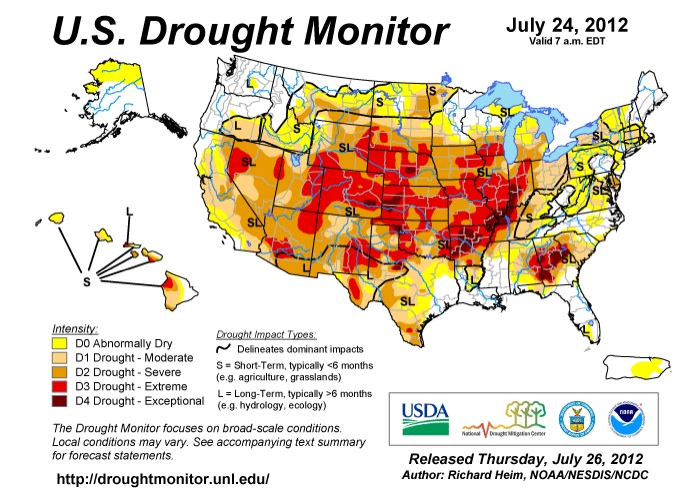
Yesterday the USDA announced that Illinois farmers are eligible to apply for emergency assistance because of the drought.  The dry conditions intensified in Kansas and Nebraska while relenting slightly in Iowa.  There are even extreme drought conditions in Hawaii forcing ranchers to reduce their herds as they struggle to grow grass to feed cattle.  Hawaii is used to some drought conditions, because of El Nino conditions on the island, however some ranches are complaining of up to eight years of drought conditions.

Agricultural Secretary Tom Vilsack announced on Tuesday that the federal government will help farmers, ranchers, small businesses, and communities by purchasing $170 million of pork, lamb, chicken and catfish for use in food banks.  This is enabled by the Emergency Surplus Removal Program, where the USDA can use funds to assist farmers and ranchers by purchasing meat.

So, the federal government subsidizes corn monocultures, which deplete the soil and reduce its ability to hold water, in order for it to mostly be fed to animals.  Then, when these especially drought-vulnerable plants are killed by a drought (which will become more common with droughts), the government resubsidizes the system by purchasing the meat of animals that became too expensive to feed because of rising feed costs.  Of course, emergency farmer aid is very important, and the drought has become a state of emergency in much of the Midwest.  But how much longer can we support such an unsustainable agricultural system that simply doesn't work in this environment?

By the way, as Grist's headline reads: "Pesticide-resistant insects add insult to drought injury".  Remember this post about scientists' concern about root worms developing a resistance to Bt Corn? It's happening! Here is an excerpt of the article that really confirms how a more balanced agricultural and food system would be more resistant to these environmental (and some unnatural) issues:

www.ent.iastate.edu/imagegal/coleoptera/rw/3936.69wcrw.html
The sad irony is that farmers don’t need to transform themselves into organic farmers to keep their crops from being worm food — though that may be the best approach for developing more drought-tolerant fields. Historically, farmers managed corn rootworms through traditional crop rotations. These rootworms eat corn exclusively, so by alternating a corn crop with soy or another alternative, farmers would deprive the insects of food and the rootworm larvae would die off. This, by the way, is an age-old technique (originally part of the Native American Three Sisters agricultural tradition) that generates profits only for the farmer — not for seed companies.

Just this weekend, at the Summer Conference, I went to a workshop about edible forest gardens and we discussed the Three Sisters method of growing.  Even with the greater distance between corn stalks required for this polyculture, corn and beans grown together are both more productive than when grown individually!

That is the power of sustainable agriculture proved over the course of thousands of years.
Kristiane

Tuesday, August 14, 2012

A Report from the Organic Land Care Program's Advanced Workshop!


Review by Jenna Messier
Rye Country Day School's beautiful organic grounds were a perfect place to host the workshop!
On August 9, 2012, the NOFA Organic Land Care Program held its second Advanced Workshop, “Compost Tea and Air Spading” at Rye Country Day School in Rye, New York.  The workshop was a huge success, with over 50 attendees from 5 states, informative presentations, and two outdoor demonstrations.

Michael Almstead, Vice-President of Almstead Tree and Shrub Company, developed the workshop and taught sessions:  Setting up the Business, Soil Food Web Tests, Estimating the Hidden Costs, and Intro to Brewing.  Dan Dalton, ISA Master Arborist, taught the Soils and Air Spading Protocol sections.  The full presentation may be seen at:  www.almstead.com/presentations/8-9-12.pdf.
Michael made some excellent recommendations regarding compost tea.  Before brewing your tea, assess the quality of your compost source by requiring the supplier to provide you with Soil Food Web test results.  Secondly, Michael suggested using annual Soil Food Web test results to measure the effectiveness of your compost tea program over time on an individual property, and to determine future applications. Thirdly, Compost tea is a knowledge-based practice, and anyone who brews tea must be trained to use the microscope and to identify beneficial or harmful microorganisms – or you may just be spraying “dirty water.”
Dan Dalton presented a soil review and then described the different forms of Air Spading such as radial trenching, root collar excavation, vertical mulching, and sheet excavation which are different patterns of excavating the tree roots by blowing pressurized air into the soil surrounding roots.  The exposed roots’ health is then evaluated and the area backfilled with compost and amendments, such as zeolite to reduce compaction and rhizoscience containing humates and kelp.

Russell Wagner of Almstead Tree and Shrub Company led the on-site Air Spading demonstration of an old Cut-Leaf European Beech tree which was suffering under compacted soil.  

 He shared best practices with the group, such as inspecting your equipment before use and always using ear protection.  AOLCP Eileen Fisher volunteered to try out the air spade and extended a radial trench.  The group was able to inspect the roots of the tree for damage, noting the lack of root hairs, before back filling the area. The day finished with a compost tea application on turf, performed by Marc  San Phillipo  The tea which had been brewed that morning was poured into the tank of a large spray truck.  Two employees reeled in the hoses while Mark walked across the lawn lengthwise while spraying 10 foot sections.  He also used a root feeder attached to the compost tea tank and applied tea directly to the root zone of an elm tree.
NOFA Organic Land Care Program extends many thanks to Almstead Tree and Shrub Company for donating their time, equipment and expertise in order to create and run this informative program.  Thanks go out to Rye Country Day School for hosting the event as part of their commitment to environmental sustainability.  Thanks to Peter Schmidt from Compostwerks who sponsored breakfast and brought his truck and equipment for attendees to view.

Wednesday, July 25, 2012

A Picture is Worth a Thousand Words

As the Farm Bill debate goes on and is in sharp contrast with a devastating drought that has affected agricultural yields across the country.  According to David Rogers at Politico, Republicans in the House might not call up the New Farm Bill for a vote before the law expires on September 30.  Rogers reports that no Farm Bill, once out of committee, has ever failed to be called for a vote.  In Rogers' article today, the House's Republican leadership is considering extending the old Farm Bill while Democratic Representatives Debbie Stabenow (Michigan) and Collin Peterson (Minnesota) insist that extension is not an option because the drought requires specific political action and there is agreement that direct cash payments to producers must be ended with the new Farm Bill.

Check out the hidden costs of the Farm Bill that's about to expire - it makes it pretty clear why these laws require replacement and the reasoning behind calls for improvements in the Farm Bill.  And also why the new Farm Bill's deep cuts to the Food Stamp program and nutrition programming are pretty disconcerting.  
Infographic from Takepart.com

Best,
Kristiane

Thursday, July 12, 2012

The Far Reach of Pesticide Contamination

In the past couple days, three articles have caught our eye in the CT NOFA office:

Owner responsibility for private well quality is at heart of contamination issues in state
This article raises some important questions about water quality in Connecticut wells.  As this study in Woodbridge proved pesticide use - even by neighbors, can contaminate wells.  This article shows that Connecticut's health code only requires testing when a well is initially built after that homeowners are "on their own."  It is recommended that homeowners test their wells regularly (but most never test their well water). Based on these findings, a filter might be available that addresses particular contaminants.  Spiegel points out that New Jersey is considered a model for Connecticut on well water quality and monitoring because the state requires that well water is tested each time a house or property is sold.

"Pesticides found in LI Sound lobsters for the first time: more study planned"
Image: Council on Environmental Quality
Enough pesticides have been applied to Connecticut's lawns that these chemicals have run off through Connecticut's rivers, into Long Island Sound, where they were still in a high enough concentration, that traces could be found in the organs of lobsters.  The article, by Jan Ellen Spiegel, explains that it had been thought that lobster die-off was due to rising temperatures in the sound.  But these recent findings might mean that pesticide run-off also might play a role in lobster die-offs.  According to this 2008 New York Times article "Connecticut Lobstermen Hope for a Reprieve, the die-off in the late 1990s was thought to kill 80% of Long Island Sound's lobsters.  The lobster industry brought in just under 12 million pounds a year leading up to 1999 and after that the catch dropped to 2-3 million pounds per year.

Environmental Threats to Children's Health
Image: Autism Speaks Official Blog
This article, by Margie Kelly, explains that the prevalence of childhood diseases is increasing, rapidly.  Child cancer rates are rising, as are developmental disabilities.  Kelly focuses on the prevalence of autism (1 in 88 children are affected by autism, a 23% increase since 2006).  In this video, Dr. Phillip Landrigan discusses the connections between these diseases and phthalates, BPA, flame retardants and pesticides. Dr. Landrigan recommends avoiding the use of pesticides, feeding children organic vegetables, and taking off shoes to decrease the amount of pesticides tracked inside.  Check out these steps to reducing pesticide exposure.

Sorry for the depressing post - but the fact is that people can be exposed to pesticides in food and water, and these chemicals are definitely threatening.  These findings are scary, but they also require continued action.  Consumers can be aware and protect themselves, and that makes a big difference.  Consumers also need to pressure the companies that produce and use these chemicals which are poisonous to animals, people, and the animals that people eat.  

Friday, July 6, 2012

FAMILY FARMERS CHARGE AHEAD IN BATTLE AGAINST MONSANTO: Ask Appeals Court to Reinstate Case Challenging Patents on Seed

The lawsuit against Monsanto continues.  Read the press release from the Public Patent Foundation below:


Seventy-five family farmers, seed businesses, and agricultural organizations representing over 300,000 individuals and 4,500 farms filed a brief today with the United States Court of Appeals for the Federal Circuit in Washington asking the appellate court to reverse a lower court's decision from February dismissing their protective legal action against agricultural giant Monsanto's patents on genetically engineered seed.
The plaintiffs brought the pre-emptive case against Monsanto in March 2011 in the Southern District of New York and specifically seek to defend themselves from nearly two dozen of Monsanto's most aggressively asserted patents on GMO seed. They were forced to act pre-emptively to protect themselves from Monsanto's abusive lawsuits, fearing that if GMO seed contaminates their property despite their efforts to prevent such contamination, Monsanto will sue them for patent infringement.

“Monsanto is known for bullying farmers by making baseless accusations of patent infringement,” said attorney Dan Ravicher of the not-for-profit legal services organization Public Patent Foundation (PUBPAT), which represents the plaintiffs in the suit against Monsanto known as Organic Seed Growers and Trade Association et al. v Monsanto. “They've sued and harassed other farmers who wanted nothing to do with their genetically modified seed and now that organic and conventional farmers are fighting back, they claim they would never do such a thing without backing up their words with an enforceable promise.”

In an attempt to sidestep the challenge, Monsanto moved to have the case dismissed, saying that the plaintiffs' concerns were unrealistic. In February 2012, the district court took Monsanto's side and dismissed the case, ridiculing the farmers in the process. Despite the fact that the plaintiffs are at risk for being contaminated by genetically modified seed and then sued for patent infringement by Monsanto, Judge Naomi Buchwald of the Southern District of New York dismissed the case because she didn't find a case worthy of adjudication, saying “it is clear that these circumstances do not amount to a substantial controversy and that there has been no injury traceable to defendants.”

Plaintiffs feel otherwise. Two of the plaintiffs submitted sworn declarations in the case highlighting the prevalence of contamination by genetically modified seed. Both Chuck Noble, an alfalfa farmer from South Dakota, and Fedco Seeds, a seed distributor in Maine, have repeatedly discovered GMO contamination in purportedly conventional seed they sought to purchase. To protect themselves from being contaminated, they have had to adopt expensive and time-consuming genetic testing procedures.

"We have a right to farm the way we choose,” said Maine organic seed farmer Jim Gerritsen, President of lead plaintiff Organic Seed Growers and Trade Association (OSGATA). “Yet Monsanto is unwilling to control their GMO pollution and they refuse to sign a binding covenant not-to-sue our family farmers for patent infringement should their seed contaminate our crops. Monsanto’s publicized ‘Commitment’ promising that they would not sue farmers was described by Monsanto’s own lawyers as being ‘vague.’ The law says we deserve protection under the Declaratory Judgment Act. We will continue to pursue our right to farm, and the right of our customers to have access to good clean food and seed.”

Other plaintiffs have simply stopped growing certain types of crops due to the threat of contamination. Bryce Stephens, a certified organic farmer from northwest Kansas, had to give up on trying to grow organic corn and soy once his neighbors started using Monsanto's genetically modified seed because it could easily spread onto his property and contaminate his organic crops, which would put him at risk of being sued for patent infringement by Monsanto.

“It’s time to end Monsanto’s scorched earth legal campaign of threats and intimidation against America’s farmers. Family farmers should be protected by the courts against the unwanted genetic contamination of their crops,” said Dave Murphy, founder and executive director of Food Democracy Now!, a grassroots community of more than 300,000 farmers and citizens dedicated to reforming food and agriculture that is co-plaintiff in the suit.

In the brief filed today, the plaintiffs point out numerous errors in the district court decision that warrant reversal. Among them are the lower court's failure to accept certain facts alleged by the plaintiffs that were undisputed by Monsanto, application of too harsh a legal standard on the plaintiffs to show the existence of a controversy, and neglect of public policy that encourages broad jurisdiction be available to those challenging bogus patents like Monsanto's.

Watch Jim Gerritsen, president of the Organic Seed Growers and Traders Association.  


Friday, June 15, 2012

Deb Legge's Homestead

Today we have a Guest Blog Post from the Organic Land Care Program's Director, Jenna Messier!
“Deb Legge’s Homestead” interviewed by Jenna Messier
You may imagine that the CT NOFA staff members each have beautiful, exemplary gardens at their homes.  In the case of CT NOFA office manager, Deb Legge -this is true!  Deb has a unique and charming homestead in Wallingford which all neighbors and visitors admire.  She lives in an old farmhouse on .5 acres of land, and she has craftily utilized her space to create a mini-farm with chickens, a greenhouse, a lovely screened-in patio and flowers spanning seasons.
I thought I would interview Deb, to find out how she has created this suburban paradise, so our readers will know what is possible.

Jenna:  When did you start your garden?
Deb: I moved into my house in October 1993 and brought about 50 pots of plants with me from the house I'd been renting. I left them under a snow bank for the winter and started the first garden the following spring. There had been a vegetable garden there and some mint scattered around, so I cleaned it all up and just started planting.
Jenna: Did this design evolve, or did you always know the type of garden you were envisioning?
Deb: It's definitely evolved over time as I've taken more of the lawn out and trees have come and gone. There's just enough lawn left now to walk on and play an occasional game of bocce during a family get together.  I've always liked jumbly cottage-style gardens, so you'll find herbs in the flower beds and a stray tomato plant out by the compost bins.
Jenna:  What edibles are you growing and how many seasons are you in food production?
Deb:  With the little unheated greenhouse, I have fresh produce most of the year. Last winter was pretty mild and there was lettuce, chard and mache in there. If you plan in late summer to have things started before it gets cold, they'll start growing again as soon as the days get noticeably longer in late January/early February.
For perennial edibles, I have several kinds of raspberries, blackberries, red and black clove currants, grapes, figs, rhubarb, asparagus, Egyptian onions, horseradish, Jerusalem artichokes. For the past couple years I've been adding some small tree and shrub fruits and nuts.  Two years ago I added 9 smallish hazelnuts and just this year put in a couple each of beach plums, Nanking cherries, western sand cherries and elderberries.
For the rest of the edibles, many of the usual like tomatoes, cukes, lots of greens, peas, beans, peppers. Except for the peppers, I either direct seed or start everything in the greenhouse.
Jenna: Did you have any problems with the town or your neighbors when you decide to have chickens?
Deb: My neighbors have been just fine. There are other chickens in the area, and no one seems to mind. At the risk of outing myself, I didn't even check with the town and couldn't find any information about whether there are even any ordinances for or against keeping a few hens.
Jenna: How many hours per week are you spending in your garden on maintenance?
Deb: The question that's always hardest to answer! I guess a lot in the spring, especially for a new project or renovation, but once everything is in and planted, probably just a few hours a week.  But it's my form of exercise, sanity-keeping and much of our food, so I don't even think of the time involved, except that I wish I could spend more time there!
Jenna:  Would you share an estimate of what you spend per year on your mini-farm, to cover the costs of chicken food, potting soil, plants etc.?
Deb: For the three hens, I only need to buy layer feed (organic, of course!) every few months, as they love to eat a huge variety of weeds and kitchen scraps, so maybe $10 a month for them.  As to the rest, I buy very few imports and not many plants any more.  I make compost, buy an occasional batch of mulch and lots of seeds, but still spend less than a few hundred dollars a year. Good potting soil is probably my biggest expense, and I get that once a year through the NOFA bulk order.
Jenna:  Do you have any suggestions for the aspiring gardener who wishes to have their own garden paradise on a small lot under an acre?
Deb: Start small! Even in the smallest yard you can grow a little something. And make friends with a more experienced gardener. I've never met a gardener not willing to share time, plants and experience with someone willing to ask and spent some time with them.
Thanks for sharing with us, Deb!  And Friends, keep working your soil and tending your garden dreams!


Wednesday, June 6, 2012

New York City's Big-Soda Ban

By  now you have probably heard of Mayor Michael Bloomburgs plan to amend the New York City Health Code in order to establish 16 ounces as the maximum size for sugary drinks.  This would only be for containers served for immediate consumption like restaurants or theaters. The plan has drawn a great deal of criticism, and the CT NOFA staff weren’t sure how we felt about it. 

On one hand is the argument that adults can and should make their own decisions, especially about their own food consumption (as Jon Stewart pointed out on the Daily Show).  Also, the ban does not actually stop anyone from drinking more than 16 oz of soda, they can just buy a second drink.  The main argument is that, consumers must learn about nutrition and how to make these healthy choices, instead of having someone legislate their behavior. 

On the other hand (which I'm starting to lean towards as I read more) is that portion sizes are huge in the United States, and these unlimited portion sizes are probably the greatest contributor to America's obesity epidemic.  The issue is not as much our food choices (every culture has some delicacies and foods that are unhealthy, but delicious).  Take for instance, this infographic from the Center for Disease Control:

Even people who are very careful about their consumption and aware of proper portion sizes, just don’t have the self-control to “save half their meal for later” or “share with a friend” - the recommended methods to beat big portions.  According to this column in the Huffington Post (and the infographic above), sodas are six times larger than they were 60 years ago, and Americans consume 200-300 calories more per day than 30 years ago. 

Whether the obesity epidemic is addressed with more aggressive education initiatives or legislation (preferably both), Bloomberg's impatience and desire to take immediate action is an attitude more politicians should have.  Political affiliation and personal health decisions have little to do with the truth that drinking large amounts of soda can cause weight gain, weight gain can lead to obesity, and obesity is a serious health condition.

This Report “Economic Causes and Consequences of Obesity”published in Annual Reviews in 2005 found that: “Much of the rise in energy intake is related to increased consumption of carbohydrates. In 1976–1980, adult men and women aged 20–74 years consumed daily 1039 and 700 kcal of carbohydrates, respectively. In 1999–2000, these numbers increased to 1283 and 969 kcal (10). Beverages, particularly fruit and soft drinks, are also responsible for a surprising number of calories. In 1997, the average American consumed 53 gallons of soft drinks and 17 gallons of fruit juices or drinks, a 51% and 40% increase since 1980 (55).”

A press release from Mayor Bloomberg’s office explains “Obesity is the only major public health crisis in America that is getting worse and nearly 60 percent of New York City residents are currently overweight or obese. In addition to the toll on health, the costs to the public are steep: in New York City $4 billion is spent annually on health care costs related to obesity. The Mayor’s Task Force on Obesity has proposed initiatives – including limiting the size of sugary drinks, significant contributors to the epidemic – with the goal of reducing the percent of obese adults by 10 percent and children by 15 percent over the next five years. “

The statistics for the United States as a whole are staggering. In 2007, diabetes cost the United States $174 billion in medical expenditures and reduced productivity and in 2008, obesity expenses totaled about $147 billion. By comparison, cancer (of all kinds) cost the United States $125.5 billion in 2010.

Also, as this debate plays out, keep in mind the American Beverage Association's political and economic power. As Nancy Huehnergarth points out in her column in Huffington Post, the ABA spent close to $13 million in New York in a six-month period in 2010, lobbying against a proposed penny-per-ounce statewide soda tax.  No one wants there to be large soda sizes available more than soda companies themselves.


Here's to healthy hydration!
Kristiane


Friday, June 1, 2012

Save the date for the NOFA Summer Conference!

The NOFA Summer Conference is August 10-12 at UMass Amherst and it's time to add it to your calendar! There are two keynote speakers this year:Chellie Pingree, an organic farmer and a member of the Agriculture Committee in the U.S. Congress. She introduced the Local Farms, Food and Jobs Act-a comprehensive package of reforms to agriculture policy that will expand opportunities for local and regional farmers and make it easier for consumers to have access to healthy foods. Jeffrey Smith, (yes, of CT NOFA Winter Conference fame) a consumer advocate promoting healthier non-GMO choices and author of the world's bestselling and #1 rated book on the health dangers genetically modified organisms (GMOs). His meticulous research documents how biotech companies continue to mislead legislators and safety officials to put the health of society at risk, and the environment in peril.The program of workshops is up on the website, nofasummerconference.org.  AND, we have scholarship money for farmers with fewer than ten years of experience! The Beginning Farmer Project of CT NOFA, supported by the Beginning Farmer and Rancher Development Program of the National Institute of Food and Agriculture, USDA, Grants #2010-49400-21847 and #2011-49400-30510.We are offering partial scholarships for attendance at the NOFA Summer Conference.  Please fill out the scholarship application https://nofa.wufoo.com/forms/summer-conference-scholarship-form-connecticut/ before July 2 so you can hear back if you received a scholarship and still get the early registration rate (deadline July 10).

Have a wonderful weekend everyone!

Best,
Kristiane

Tuesday, May 29, 2012

How to Save Seed in an Orderly Manner: Advice on an easy way to get started saving seeds

                The first step is to make sure that the crop you are interested in saving seeds from is not a hybrid plant, but rather a one that is open-pollinated. This is because hybrids do not “come true” from the saved seeds from each generation to the next the same way the open-pollinated seeds do. Ken Green of the Hudson Valley Seed Library says that the best way to start is with something small and easy such as crops with a perfect flower and a pod, take beans and peas for example. Perfect flowers are plants with both stamens and pistils (male and female parts). Examples of these plants are lettuce, tomatoes, and beans. Imperfect ones are plants where the crop has separate male and female flowers, such as squash and cucumbers, making them not quite as easy to save the seeds as the plants with perfect flowers.
commons.wikimedia.org      
                Ken recommends that beginning seed-savers try out saving the seeds of easy crops such as bush beans, because they do not cross pollinate as much as pole beans. As well as peas, as long as you make sure to leave a few pods to dry on the vine, and cilantro or tomatoes. 
The key is to prevent cross pollination from occurring because that can have a great impact on your crops. Kens example of this is “the offspring of a sweet pepper may not be so sweet next year if a hot pepper’s nearby”, one way to prevent this from occurring is to just grow one type of crop to “be sure that your seed will be pure”. If you aren’t willing to grow only one type of plant or are not able to isolate different varieties from each other you might want to consider growing one from each of the following groups in order to minimize cross-pollination
  • Mixta: Cushaw types, some gourds
  • Moschata: ‘Butternut,’ Cheese types 
  • Pepo: ‘Acorn,’ Field Pumpkin, Crookneck, Scallop and Zucchini types.
  • Happy Seed Saving!

All of the above information has come from the following article: http://awaytogarden.com/thinking-about-saving-seeds-with-ken-greene
Images from: thrivefarm.wordpress.com, commons.wikimedia.org