Wednesday, October 23, 2013

Good Local Food and the Food Safety Modernization Act by Bill Duesing

The growth of the good, local food movement has been a real bright spot in Connecticut for at least a decade. Vibrant farmers markets have been growing in number and lengthening their seasons.  More Community Supported Agriculture farms (CSAs) connect consumers directly with farms and seasonal food.  College and school farms and gardens are expanding and new farmers, young and old, are looking for a meaningful life producing our fundamental need.  

We have a common interest in feeding ourselves and our communities with fresh, healthy, beautiful and safe produce. There is very little that has so many positive effects- economic, social, health, environmental, aesthetic- as the blossoming and vital local food movement.

But watch out:  Here comes the Food and Drug Administration (FDA) with Food Safety Modernization Act (FSMA) to slow all that down, maybe even stop it, if the proposed rules are allowed to stand.  We all have an interest in commenting on these rules. 

Wednesday, October 16, 2013

The Triumphs and Disasters in Home Gardening from the Staff at CT NOFA


Executive Director, Eileen Hochberg, discusses fighting worms for her brussels sprouts!
"This year for the first time ever absolutely everything in my vegetable garden was started from seed - organic seed of course. Being a lover of all brassicas, most notably kale,
  I just had to take on another favorite, the biggest brassica challenge of all - brussels sprouts. In so doing I now realize that successfully growing brussels is a nearly year long endeavor. Having planted the seeds inside in February, I am still nurturing the plants and still fighting the cabbage worms, as I hear the brussels will improve with frost and can be left growing until November. I have to add that cabbage worms have been my biggest trial and tribulation of the season, and since the garden is filled with brassicas that has meant a real fight to determine who gets to the kale, broccoli...and brussels....first. Never again will I plant without row cover in the spring to ward off the army of cross-striped cabbage worms that followed the green cabbage worms and then the green cabbage worms that followed the cross-striped!" 

Tuesday, October 1, 2013

Organic Agriculture and Thinking in three parts By Bill Duesing, Organic Advocate


Organic Agriculture and Thinking in three parts 
By Bill Duesing, Organic Advocate
Gleanings, October 2013 

1. Use Nature’s methods/ work with Nature.

2. Pay attention to:
  •      where things come from
  •      where things go, and
  •      what the effects are at both ends and along the way.
3. Think holistically.

For years I’ve used these three points to illustrate what organic agriculture is and by extension what an organic attitude for living on this beautiful planet should be.

CT NOFA goes to Farm Aid 2013!


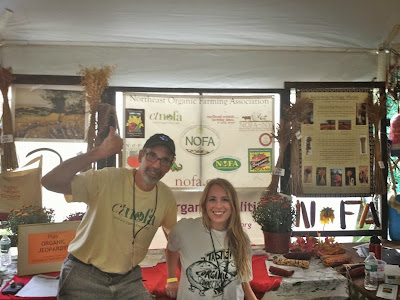
John and I representing CT NOFA at the Homegrown Village
Any followers of CT NOFA will know that this week had been a whirlwind of planning and organizing our fabulous Special Culinary Fundraiser at Winvian (in case you weren't there, you definitely missed out), but we now can take some time and reflect on some of the events CT NOFA has been able to be a part of as the summer officially drew to an end. One of the most exciting event we were able to participate in was this years annual Farm Aid benefit concert in Saratoga Springs, NY last Saturday. Representing CT NOFA for the day at the interstate NOFA booth were Board Member John Turenne and Event and Program Manager Stephanie Berluti (Me). 


Tuesday, September 10, 2013

The Japanese Food System Experience (So Far)

Greetings from Hayashima, Japan!

It's been about a month and a half since I left Connecticut to spend a year teaching English in Japan, and in that time I (and my stomach) have begun to get used to life here. I am by no means an expert on Japan's food system at this point, nor will I likely ever be, but there are some similarities and differences between the American way of producing and consuming food and the Japanese way of doing so that became clear almost as soon as I arrived.

Similarity: Both Japan and the United States have a country-wide food distribution network
This is a picture of Marunaka, a supermarket chain with a store right here in my town. This particular picture isn't of my town's store, but the one in Hayashima looks similar. There is parking available for both bikes and cars as many people (myself included) ride bikes around town. Marunaka stocks foods and household goods from all over Japan and is fairly sizable, although nowhere near as giant as a Costco or Super Walmart. Since arriving in Japan I haven't heard of or seen anything like that.


Difference: Japan's food distribution network focuses heavily on Japanese products
Or at least it does in my experience so far. And not only does it focus on Japanese-grown products, but also regional and local products. The Pione grape and white peach are both specialties of the region I am living in, and are available, seasonally, right as you walk into the store. Local fish from the inland sea near my town makes up a large percentage of the seafood selection, and even dry goods like rice have labels displaying what prefecture the grains came from.


Tuesday, September 3, 2013

Organic Agriculture and Thinking in three parts, By Bill Duesing, Organic Advocate


By Bill Duesing, Organic Advocate

Organic Agriculture and Thinking in three parts

1. Use Nature’s methods/work with Nature. 
2. Pay attention to:
  • where things come from
  • where things go, and
  • what the effects are at both ends and along the way.
3. Think holistically.

For years I’ve used these three points to illustrate what organic agriculture is and by extension what an organic attitude for living on this beautiful planet should be.

They have held up very well over time.

Tuesday, August 13, 2013

Joan Allen teaches us about Plant Diseases!

Last Monday CT NOFA collaborated with the wonderful Community Farm of Simsbury to put on our forth on-farm workshop of the summer; Plant Disease management presented by Joan Allen, the Assistant Extension Educator at UConn's Home and Garden Education Center. It was the perfect day for an on-farm workshop as the temperature was a cool 73 degrees, a nice break from the recent heat wave that has struck CT.