Showing posts with label Urban Agriculture. Show all posts

Wednesday, September 12, 2012

Join us for our Third Block Party on the Farm!

Urban Oaks Organic Farm is a wonderful place to come relax as the summer winds down.  It's also an impressive site to learn about - this healthy and productive farm represents a success story of brownfield remediation and site renovation.  This article from a couple years ago provides an overview of Urban Oaks' history, starting back before Urban Oaks existed.  Here's an except that talks a little about the farm:
Urban Oaks Organic Farm opened on a portion of the Sandelli site in 1999. The farm provides education for residents and school groups in organic gardening methods, sustainable agriculture, nontoxic farming techniques, composting, and other environmentally friendly farming techniques. The establishment of the organic farm has helped enhance the urban environment by demonstrating farming responsibility, non- polluting techniques and soil amendments, pest control utilizing natural predators, and by providing greenspace in a dense and urban area.
You can learn more about the history of Urban Oaks and founding farmer Mike Kandefer by checking out this more recent Edible Nutmeg article.  Stop by this Saturday and listen to some live music, enjoy a potluck meal, and learn more about a farm that is a model of community engagement and investment.

LEARN MORE ABOUT THE BLOCK PARTY AND RSVP HERE.

Tuesday, January 24, 2012

Why Local Farming is Important

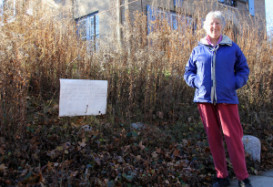
Rebecca Kline of New Haven Farms stands at the site
of a proposed community garden in New Haven.
 
An excerpt from a recent Huffinton Post Article about our local (and impressive) Common Ground Farm and High School reads, "In a 1787 letter to George Washington, Thomas Jefferson wrote, 'Agriculture is our wisest pursuit, because it will, in the end, contribute most to real wealth, good morals and happiness.' In short, farming produces not only food, but also the foundation for a good life." Growing the number of farms in our state addresses more than just food access and nutrition; it also fills a cultural void that has been present in our country ever since industrial agriculture stole the spotlight from traditional community-based means of food production. Without local farms available in and around the places where we live and work, we suffer emotionally and culturally as well as physically. In communities where there aren't many remaining farms, losing another one can be especially unsettling, as is the case with Purdy's Farm in Greenwich, one of only two farms left in the town.

But there is light on the horizon. Of late there has been a new resurgence in the number of new people, many of whom have never farmed before, developing an interest in local sustainable agriculture. In New Haven, the same city in Connecticut that Common Ground calls home, a nonprofit called New Haven Farms has set its sights on creating a new urban community farm that aims to feed 250 people in the surrounding area. Additionally, other nonprofits and farming organizations like the NOFA state chapters have implemented programs to help teach and train a new generation of farmers.

If you are interested in starting a sustainable farm and want to learn more about taking the first steps, join CT NOFA and a group of other established and prospective farmers this Saturday at the Getting Started in Organic Farming Conference in Rockfall, CT. Come and learn about the topics that are most integral to starting your farm - land access, leasing, marketing, and more. To learn more about the conference and to register, check out our website. Working together, we can change the culture of farming in our state and in our country.

Have a great day!
-Melissa

Tuesday, December 13, 2011

Wisconsin Woman Taken to Court Over Her Lawn

In Shorewood, WI, Louise Quigley, who has been living in her home for over twenty years, is being taken to court over her native lawn.  In an effort to deter schoolchildren from using her lawn as a shortcut coming home from school, she decided to plant prairie grasses, goldenrods, milkweed, and butterfly weeds, citing the ecological benefits of such a planting.

“They are less work, they come up every year, they are pretty," she says.  "Native perennials have all kinds of environment benefits because the native plants feed the native bugs, feed the birds; it’s the bottom of the food chain.  You can promote the survival of our ecosystem and our biosphere if you plant native plants.”

However, despite Louise's astute decision regarding local ecology, her prairie yard happens to violate an outdated neighborhood ordinance that her community has begun cracking down on.  The ordinance states that native lawns can't exceed six inches in height, and when Louise refused to comply with the ordinance she was summoned to court.  Louise has since been trying to push village officials to get the ordinance changed.  She argues, "(The ordinance) is about lawns and it isn't about native plant communities.  It was drafted way back and wasn't about 21st century aesthetics or a 21st century ecological understanding. I don't have a lawn, I have a prairie. They are using a lawn regulation to harass me about my prairie."

 Read more about the Shorewood community and Louise's battle here.

Have a great day!
-Melissa

Friday, November 18, 2011

Urban Roots

Last night, I had the pleasure of watching the documentary Urban Roots at a Community Potluck and Film Screening hosted by The New Haven Bioregional Group and co-sponsored by a number of organizations including CT NOFA. 
The documentary was a wonderful testament to the power of gardens and farms in urban areas.  Detroit is a powerful symbol of our society's assumptions that industry can support an economy, that an economy can grow forever and that a booming economy can replace a well-planned infrastructure and society.  In the documentary, Detroit residents complain that they live in a food desert - where they must travel at least twice the distance to a grocery store with "real" food as they would travel to a convenience store or fast food restaurant.
photo credit: inhabitat.com

Residents started growing food in their yards, and then expanded to abandoned land around the city (there is plenty of it).  They have no real right to the land - but with a city that has lost over half it's population since the middle of the 20th century - there isn't much competition for land.  Some people are putting chickens and bees in abandoned housing, or taking over multiple plots on their block to create urban farms.  The soil is tested and if it is contaminated, farmers must create soil by farming non-edible crops for a couple years and building up the soil with compost collected from near-by restaurants, breweries and homes.  Community gardens give people who are unemployed or under-employed, a job to do in their free time, and access to the food that they would like to harvest. The city government seems to be hesitant about encouraging this guerrilla gardening, since they might want to encourage housing developments (thought this seems unlikely given all of the abandoned, already standing houses), but farmers and gardeners are going ahead filling this food desert with urban farms producing healthy foods for Detroit residents. 

So if one of the most depressed run-down cities in the country can do it . . . why can't we do it in New England cities and suburbs?  Even if you don't live in a food desert - wouldn't it be better to live in the equivalent to a food rainforest? Where there is food growing everywhere, on every block, incredible biodiversity and high access, for anyone, to the food they need to eat to be healthy and happy?

One of the main themes in the movie was of self-determination.  The right to self-determination is a very powerful concept in international human rights law. According to the International Covenant on Civil and Political Rights: All peoples have the right of self-determination. By virtue of that right they freely determine their political status and freely pursue their economic, social and cultural development.  Many people interviewed in the movie, reasoned that one of the best ways of self-determination, was to rely on themselves for food and for neighborhoods and communities to have food independence.  It's pretty empowering - no matter what happens in your life, you can still provide, the only thing you really need to live - food.  

This film clearly gets you thinking - I highly recommend it.

Have a great weekend,
Kristiane

Tuesday, August 16, 2011

Ample Harvest and Urban Garden Scavengers


Even the White House is looking to home gardens and urban agriculture to improve our food system and food access inequalities.  The AmpleHarvest.org Campaign, is a national program that enables Americans who grow food in a home garden to donate excess harvest to registered local food pantries. 
AmpleHarvest.com was first created by Gary Oppenheimer because few food pantries had websites or any type of online presence for people to find them.  Since then the National Gardening Association partnered with  AmpleHarvest,.org to inform members of the opportunity to donate produce.  In July of 2011 the program partnered with Michelle Obama’s “Let’s move!” initiative with the goal of creating a healthier America. "Let's Move Faith and Communities" is a challenge to community leaders, faith-based and neighborhood organizations to help enact a number of programs and achieve specific goals including hosting 10,000 new community gardens or farmer's markets and hosting 1,000 new Summer Food Service Program Sites. 
Ample Harvest has brought fresh produce to more than 4,000 food pantries across the country adding 100 just in the month of July, 2011.  Ample Harvest estimates that more than 700,000 pounds of fresh produce have been donated to food pantries.
Local governments are taking similar approaches to leftover food in abandoned gardens.  In the New York Times article, At Vacant Homes, Foraging for Fruit,  by Kim Severson, exposes the acceptability of scavenging in abandoned gardens.  Areas with high foreclosure rates mean many empty houses and abandoned gardens.  There are government efforts to turn abandoned land into food – in Multnomah County, officials offer property seized for back taxes to community and governmental organizations for gardens.  Even after homeowners have left, these gardens provide for people living in the area.  These two trends demonstrate the importance of small gardens and urban agriculture in addressing food access problems now and in the future.